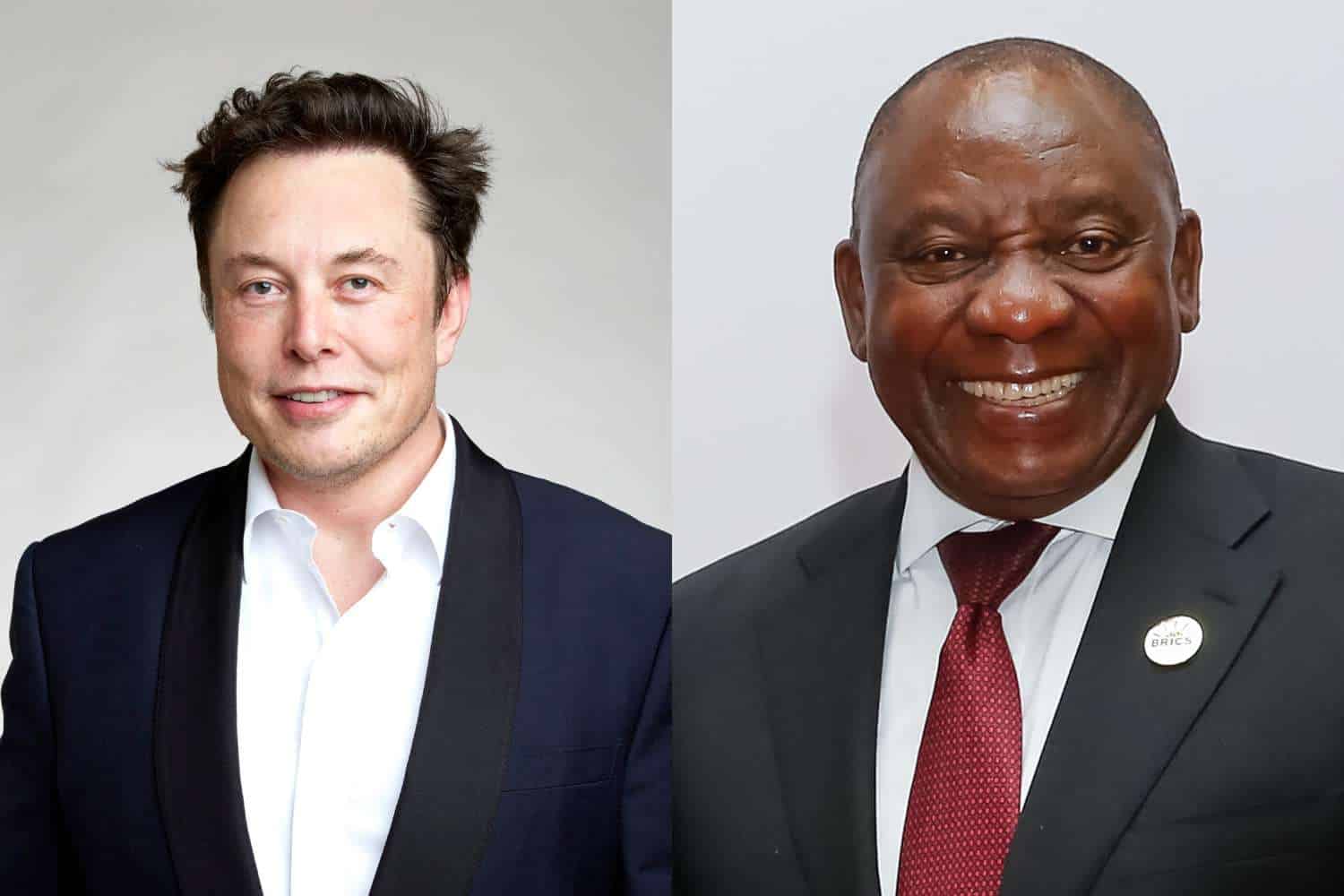


Elon Musk has escalated his public confrontation with the South African government, alleging that he was offered the opportunity to bribe his way to a Starlink telecommunications licence, and that the only reason his company cannot operate legally in the country is because he is not black. The Presidency has responded by dismissing his claims and suggesting he look for opportunities elsewhere, while the Democratic Alliance has backed Musk’s call for an equity equivalent arrangement.
SpaceX, which operates the Starlink satellite internet service, has been unable to obtain a licence to operate in South Africa because the Electronic Communications Act requires telecommunications licence holders to be at least 30% owned by historically disadvantaged groups under the country’s Broad-Based Black Economic Empowerment framework.
Musk has declined to restructure SpaceX’s ownership to comply with the requirement, and has instead taken to social media to characterise the BEE framework as discriminatory on racial grounds.
Musk’s bribery claim and the government’s response
In posts on his social media platform X, Musk alleged that a party acting on behalf of South African telecommunications interests had offered to arrange for a black person to nominally front Starlink’s South African operations, in exchange for payment.
Musk said he refused the arrangement as unethical and characterised it as direct evidence that BEE licensing requirements create incentives for corruption rather than genuine economic transformation.
The Presidency moved swiftly to rebuff the claims. Spokesperson Vincent Magwenya told reporters:
“There are currently 193 member states in the United Nations. Surely, there’s good money to be made out of 192 markets. It’s okay to move on.”
Magwenya did not directly address Musk’s bribery allegation, and the government has not indicated it will investigate the claim.
DA backs equity equivalent as vested telecom interests blamed
Democratic Alliance federal leader Geordin Hill-Lewis struck a markedly different tone, publicly supporting Musk’s bid to operate in South Africa even as he described the billionaire as “outspoken, aggressive and quite anti-South Africa.” Hill-Lewis called on the government to permit an equity equivalent arrangement, a mechanism already used by multinationals including Amazon and Ford, which allows foreign companies to meet BEE requirements through qualifying investment in the South African economy rather than through ownership restructuring.
“We can have Starlink in South Africa and have better internet access,” Hill-Lewis said.
“However, there are very powerful vested interests in the telecommunications industry that don’t want that because it is competition.”
The DA has argued that affordable satellite internet access would materially benefit rural and township communities that are currently underserved by fixed-line and mobile operators.
What is at stake for South African consumers
South Africa’s broadband penetration remains uneven, with urban areas served by fibre and 5G networks while large parts of rural South Africa depend on expensive, often unreliable mobile data.
Starlink’s low-earth-orbit satellite technology can deliver broadband to remote areas without the need for ground infrastructure, making it potentially transformative for schools, clinics, and small businesses in underserved communities.
The current licensing impasse leaves South African consumers unable to subscribe directly to the service, while Zimbabweans, Zambians, Mozambicans, and several other neighbouring countries already have Starlink access.
The Department of Communications and Digital Technologies has acknowledged it is reviewing the ICT sector’s BEE framework, but has given no timeline for any changes.