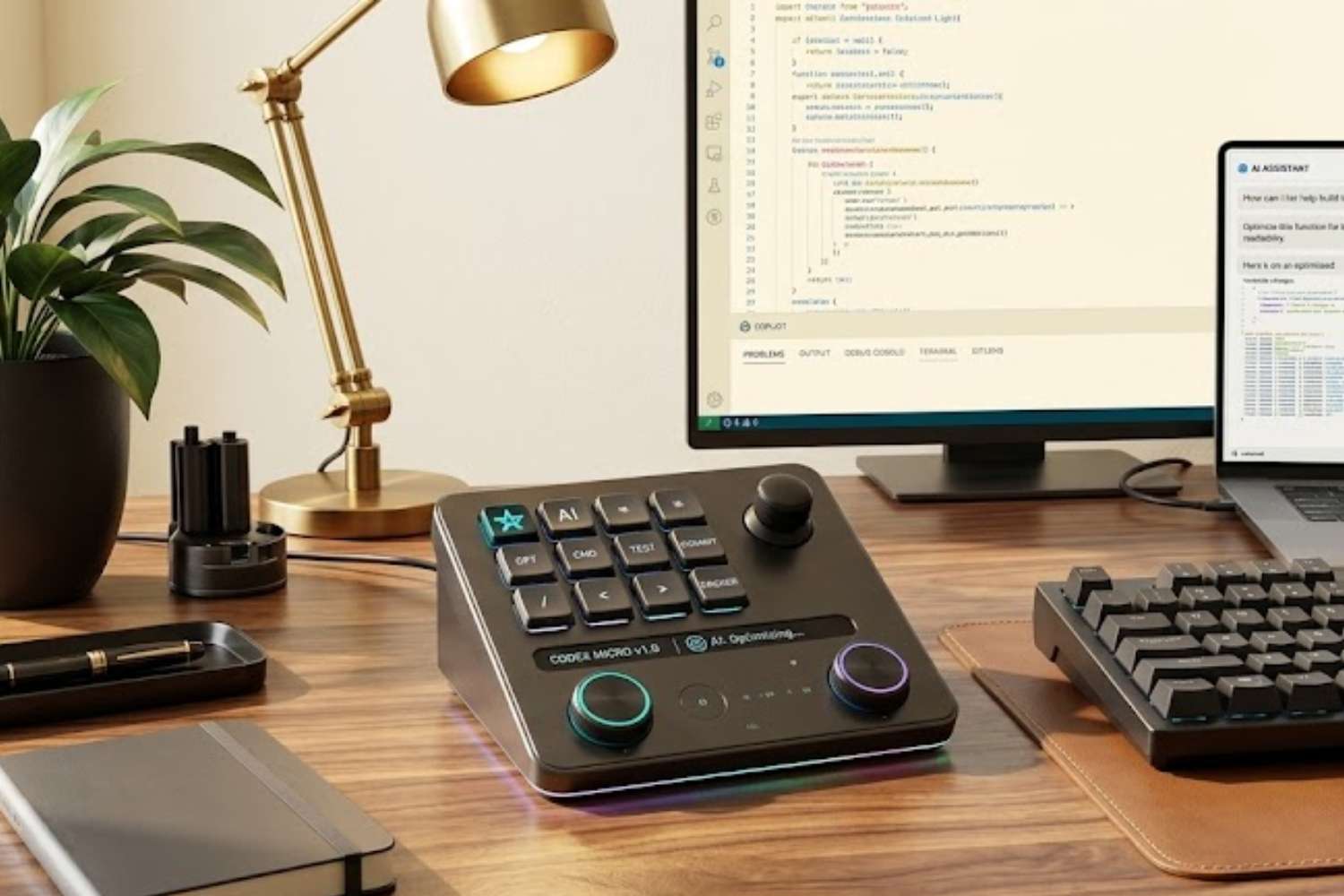


OpenAI Codex Micro, the company’s first branded hardware product, gets its full launch on Wednesday, 15 July 2026, a programmable macro pad built with keyboard maker Work Louder for developers.
OpenAI first teased the Codex Micro on 29 June at the AI Engineer World’s Fair in San Francisco, as reported by TechCrunch.
Today’s launch is when pricing and full specifications are finally due.
What the OpenAI Codex Micro actually is
This is not a phone and it is not an AI wearable. The Codex Micro is a compact macro pad, a small input device that sits beside your main keyboard and fires off shortcuts, commands and actions with a single press.
The move is a small but notable step for a company better known for models than machines. OpenAI has spent years shipping software, and a physical, brandable object aimed at its most engaged users is a different kind of bet.
The hardware is properly nerdy. It packs 13 mechanical keys, a joystick and a rotary encoder, plus six programmable layers, which means one small board can be mapped to dozens of different Codex actions depending on how you set it up.
It leans heavily on existing kit. The Codex Micro closely resembles Work Louder’s Creator Micro 2, a boutique macro pad that sells for about $199 (roughly R3 600), right down to the mechanical keys and touch-sensitive controls.
Who the Codex Micro is for
OpenAI is aiming this squarely at its developer base, the roughly 5 million weekly Codex users who already live in the tool. For that crowd, a dedicated board of Codex shortcuts is the kind of thing that sounds silly until you have one.
The Work Louder partnership matters here too. The boutique maker has a following among keyboard enthusiasts, and tying the Codex brand to that scene gives OpenAI instant credibility with the hobbyists who obsess over exactly this kind of hardware.
OpenAI spokesperson Dominik Kundel framed the device in simple terms at the reveal, calling it a keyboard “designed to supercharge people’s Codex usage.”
In other words, less a gadget for everyone and more a power tool for the people already inside the ecosystem.
Plenty is still unconfirmed. OpenAI has not said what the Codex Micro will cost, which operating systems it supports, or whether users can write their own key mappings or tap into an API to build custom workflows.
All of that is meant to land today. Once OpenAI publishes the pricing and the spec sheet, it will be clear whether the Codex Micro is a serious tool for developers or a branded curiosity aimed at the faithful.