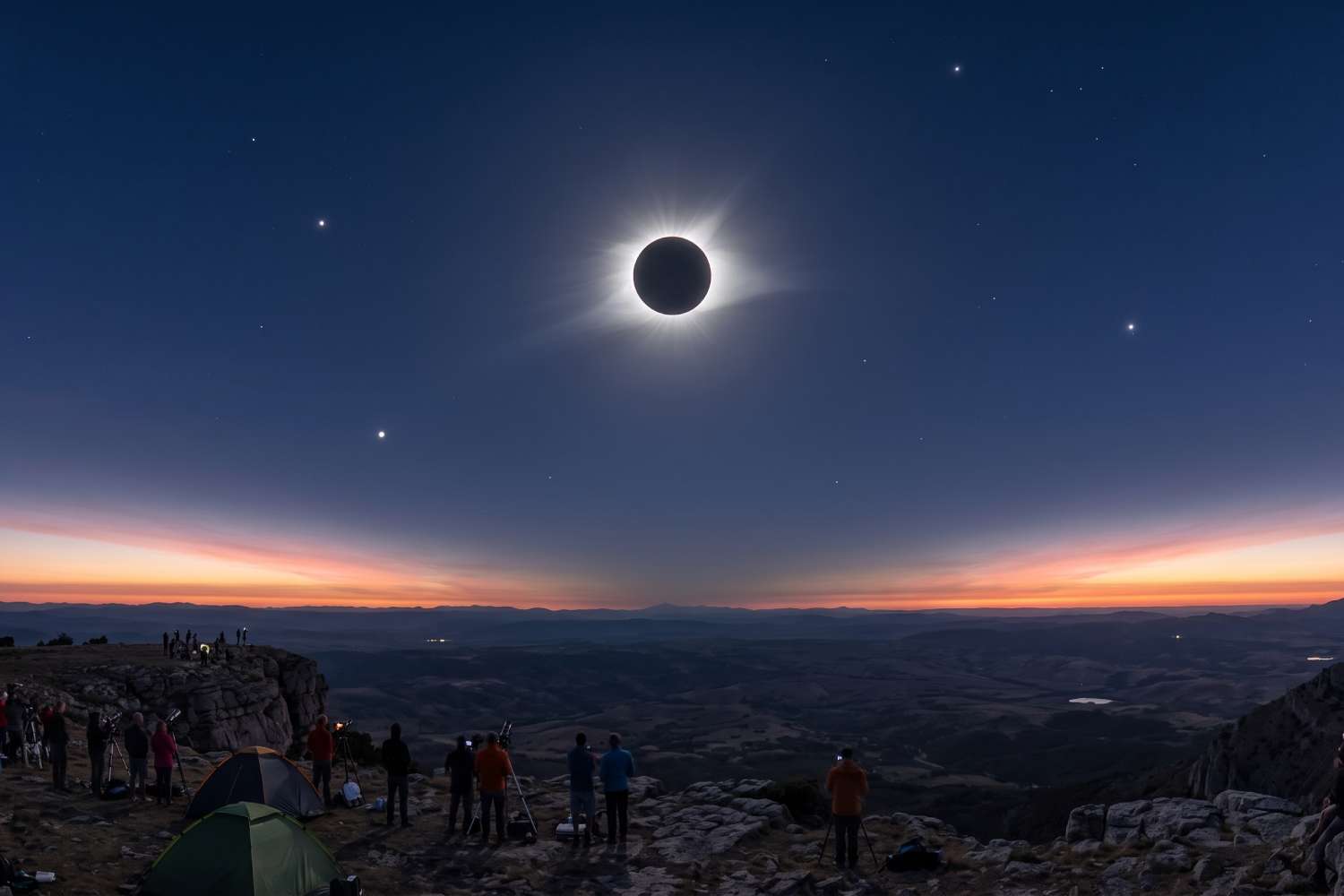


A total solar eclipse will sweep across the Arctic and parts of Europe on Wednesday, 12 August 2026, with the path of totality passing over Iceland and into northern Spain.
The path of totality begins in far northern Siberia near the North Pole, crosses the Arctic and North Atlantic, and continues on to northern Spain and the extreme northeastern tip of Portugal, according to NASA.
A total solar eclipse happens when the moon passes directly between the sun and Earth, blocking the sun’s disc completely for viewers standing inside the narrow path of totality.
Everyone else within reach of the moon’s wider shadow sees a partial eclipse, where the sun appears with a bite missing rather than vanishing altogether.
Where the solar eclipse 12 August 2026 will be visible
The point of greatest eclipse falls about 45km off Iceland’s western coast, where totality will last two minutes and 18 seconds, the longest stretch of darkness anywhere along the path.
That single point sits far out over open water, away from any major population centre.
Inside Spain, the path of totality is expected to cross A Coruña, Valencia, Zaragoza, Palma and Bilbao, putting those cities in line for a full blackout if skies stay clear.
Madrid and Barcelona sit just outside the path, meaning residents there will see a partial eclipse only.
Who else will see the solar eclipse on 12 August 2026
The rest of Europe will only catch a partial eclipse, alongside parts of North America and Africa that fall within the eclipse’s wider shadow.
None of those regions will experience full darkness, but a visible bite will be taken out of the sun where skies allow.
Timing varies sharply by region. In northern Russia the partial eclipse begins at the start of the day, while in Alaska and northern Canada it starts and ends during the morning.
Eastern Canada catches it in the afternoon, and the northern contiguous United States sees it begin around midday.
How to watch the solar eclipse on 12 August 2026
Anyone planning to watch, whether from inside the path of totality or from a spot that only gets a partial view, needs proper eclipse glasses or filtered optics, since looking directly at any part of an uneclipsed sun can damage the eyes.
Ordinary sunglasses are not strong enough for the job.
Anyone outside the path of totality will only ever see a partial bite out of the sun on the day, no matter how clear the skies are.
For skywatchers under the line running from Siberia through Iceland to northern Spain, Wednesday, 12 August 2026, is the one shot at full darkness this event offers.