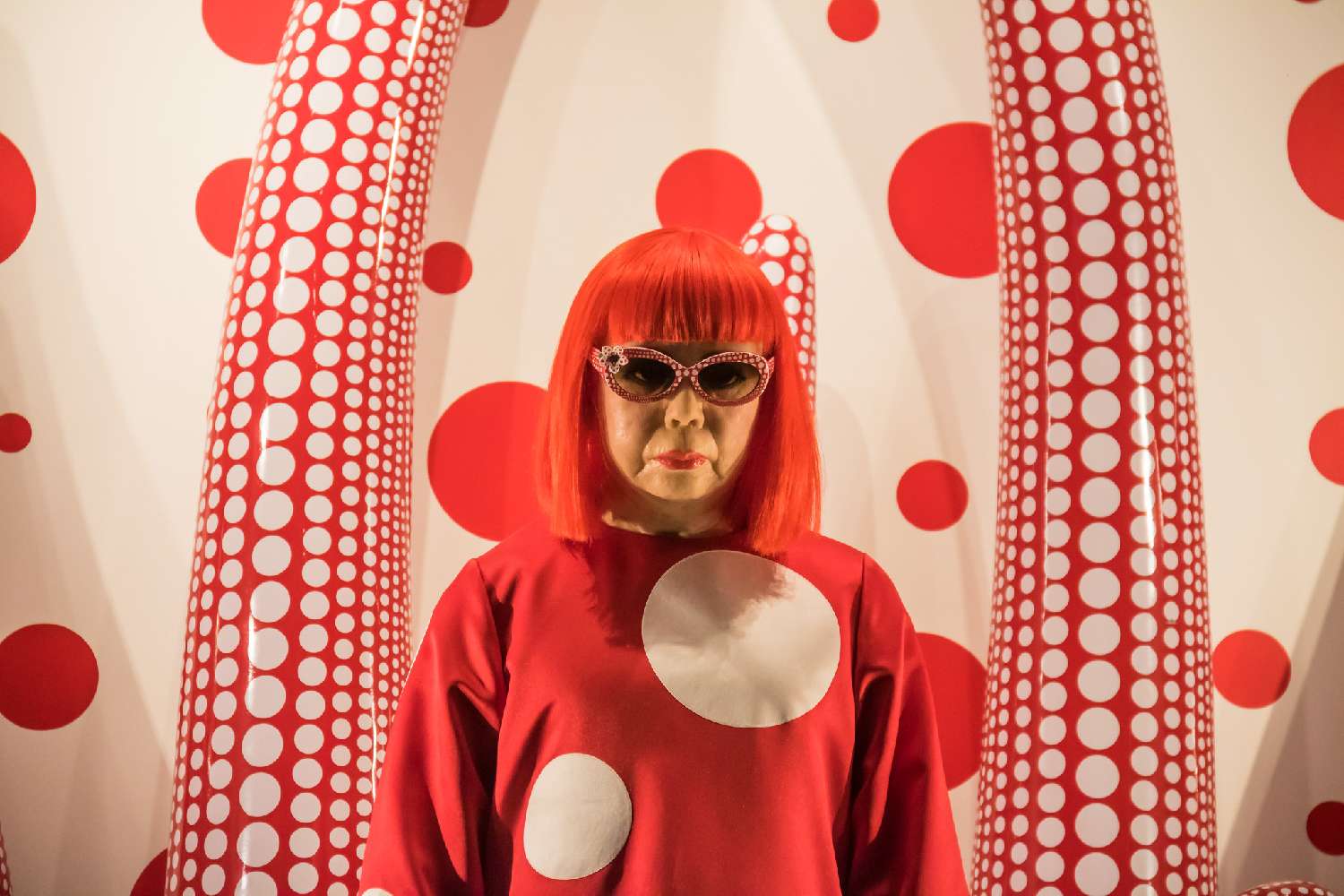


Yayoi Kusama died at 97 in a Tokyo hospital on Friday, 14 August 2026, with her company confirming the polka dot artist’s death in a statement on Thursday, 27 August 2026.
The Japanese artist behind the Infinity Mirror Rooms and those giant spotted pumpkins had kept painting to the end, and her company, Yayoi Kusama Inc, confirmed the news, as reported by The Guardian.
Her representative, David Zwirner, said multiple organ failure was the cause.
Yayoi Kusama died with her brush still in hand
The company statement laid out the sweep of a career that refused to sit in one lane, taking in canvases, sculpture, performance and the printed page. Kusama had worked across all of it for more than 70 years:
“Throughout an extraordinary lifetime devoted entirely to artistic creation, Kusama pursued an internationally acclaimed career as a pioneering avant garde artist whose creative practice encompassed visual art, performance, fiction, and poetry.”
“She continued to paint until her final days, never setting aside her brush, and continued exploration of forever love and eternal soul.”
Born in Matsumoto in 1929, Kusama grew up under an abusive mother and started seeing hallucinations as a child, flowers that swarmed and spoke to her. She drew what she saw to cope, and the dots followed her for seven decades.
She moved to New York in 1958 and pushed into the avant garde scene, staging happenings during the Vietnam War where she painted polka dots on naked protesters.
She once wrote to president Richard Nixon offering to sleep with him if he ended the war.
Her dealer Richard Castellane remembered what happened when visitors first stepped into one of the mirrored rooms, where light bounced endlessly off spotted surfaces.
He described the reaction to an American broadcaster in 2017, decades later:
“They were just mesmerised and rather overwhelmed. It was something very new.”
From talking flowers to a $7.1 million canvas
Her infinity net paintings once went for as little as $75 in 1962, snapped up by fellow artists Frank Stella and Donald Judd. By 2014 her canvas White No 28 fetched $7.1 million at auction, a record at the time for a living female artist.
The dots were never just a motif for her, and she said so often, tying the pattern on a pumpkin to something considerably larger than the gallery it sat in. Her 2024 Australian exhibition became the most popular in that country’s history, and she put the thinking behind it plainly in her own writing:
“Our earth is only one polka dot among a million stars in the cosmos.”
What happens to the Yayoi Kusama legacy now
Her company gave no timeline for how her scheduled exhibitions and museum programmes would be handled, and it did not detail any change in leadership.
What Yayoi Kusama Inc did commit to was set out clearly in its closing lines:
“We will carry forward Kusama’s wishes and, through art, continue to bring hope and strength for the future to people around the world.”
Museums holding her mirrored rooms and outdoor pumpkins, from Tokyo to the island of Naoshima, kept their doors open through the week of the announcement.
No memorial date had been confirmed at the time of publishing, leaving the galleries as the place her audience gathered.