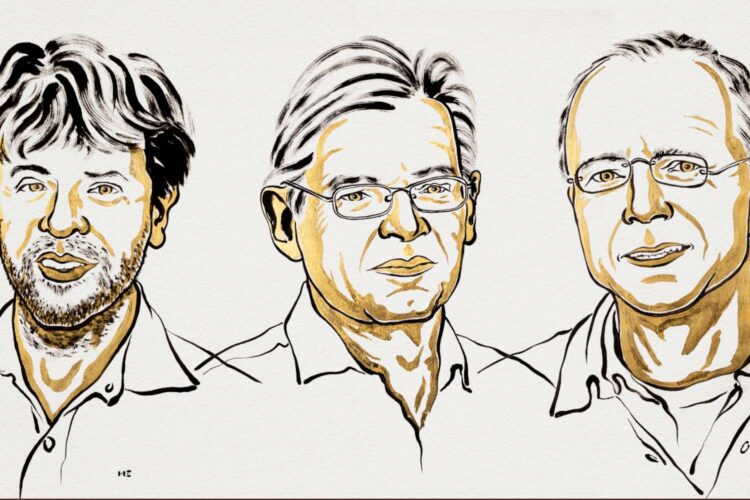


The Nobel Prize in Physics 2026 went to Francis Halzen, a Belgian physicist at the University of Wisconsin-Madison, on Tuesday, 6 October 2026, for his work on the IceCube neutrino observatory at the South Pole.
According to The Citizen, Halzen, 82, is the sole winner and receives 12 million Swedish kronor, about $1.2 million.
The Royal Swedish Academy of Sciences announced the award in Stockholm, scheduled for 11:45 local time (11:45 SAST), and the committee cited his “decisive contributions to the IceCube Neutrino Observatory and the discovery of high-energy neutrinos of astrophysical origin.”
Who won the Nobel Prize in Physics 2026?
Halzen is a professor at the University of Wisconsin-Madison, and the report says he conceived the idea for the observatory in 1988. Ellen Moons, secretary general of the Royal Swedish Academy of Sciences, summed up this year’s award in a single line when she announced the winner:
“This year’s prize is about ghostly messengers from space.”
Mark Pearce, chair of the Nobel Committee for Physics, credited Halzen with leading the international team of researchers and engineers behind the project and explained why the committee regarded the observatory as a landmark instrument:
“Francis Halzen has led an international team of researchers and engineers who have provided us with a fantastic instrument.”
What is the IceCube neutrino observatory?
Neutrinos are electrically neutral subatomic particles that pass through almost everything without being stopped, which makes them hard to catch. IceCube uses a cubic kilometre of Antarctic ice, between 1,450 and 2,450 metres below the surface, fitted with 5,160 light sensors. When a neutrino hits an ice molecule, the collision produces a flash of light that the sensors record.
In 2013, the observatory detected high-energy neutrinos from deep space, including two nicknamed Bert and Ernie. In 2017 it traced a neutrino to the blazar TXS 0506+056, a galaxy powered by a supermassive black hole about 3.7 billion light-years away, the first time a neutrino detector had pinpointed an object in space. A 2023 study identified neutrino emission from the plane of the Milky Way.
What the Nobel Prize in Physics 2026 recognises
Halzen said the award came as a surprise and that he had not expected it, a reaction recorded in reports of the announcement. The 82-year-old, who first proposed the observatory in 1988, added that he welcomed the news:
“It’s a great pleasure to hear about this prize.”
Neutrinos travel in straight lines and are not blocked by dust or gas, so they carry information that light cannot. Telescopes such as the James Webb Space Telescope, which studied the Milky Way core, collect light, while neutrino detectors add a second view.
Swisher Post‘s earlier astronomy coverage also includes the 3I/ATLAS comet.
Nobel announcements still to come
Chemistry follows on Wednesday, 7 October 2026, at 11:45 local time (11:45 SAST), Literature on Thursday, 8 October 2026, at 13:00 local time (13:00 SAST) and Peace on Friday, 9 October 2026, at 11:00 local time (11:00 SAST).
Medicine was awarded on Monday, 5 October 2026, to the pioneers of the optogenetics Nobel Prize.
Sources
- The Citizen, Nobel physics prize honours work on ghostly messengers from outer space
- Newscord, Nobel Prize in Physics goes to Belgian Francis Halzen for IceCube neutrino observations
- NBC News, A decades-long quest at the South Pole just won Francis Halzen the Nobel Prize in physics
- CBC News, Francis Halzen, Belgian physicist based in U.S., awarded Nobel prize for pioneering work on neutrinos
- Nobel Prize announcement schedule
- Wikipedia, IceCube Neutrino Observatory
- Swisher Post, Optogenetics Nobel Prize won by three, and how it works
- Swisher Post, James Webb Space Telescope unveils new mysteries in Milky Way core
- Swisher Post, 3I/ATLAS: Comet the size of Manhattan has scientists concerned