

Riemann hypothesis explained: the 1859 conjecture about prime numbers that Anthropic mathematician Levent Alpöge claimed on Friday, 20 November 2026, to have proved with Claude.
According to Anthropic, the Riemann hypothesis is that the zeros that determine the primes all sit along one vertical line, and nobody has yet proved or disproved it. Primes are numbers divisible only by themselves and one, and they look scattered at random along the number line. Riemann’s 1859 paper suggested that their spread follows a hidden pattern.
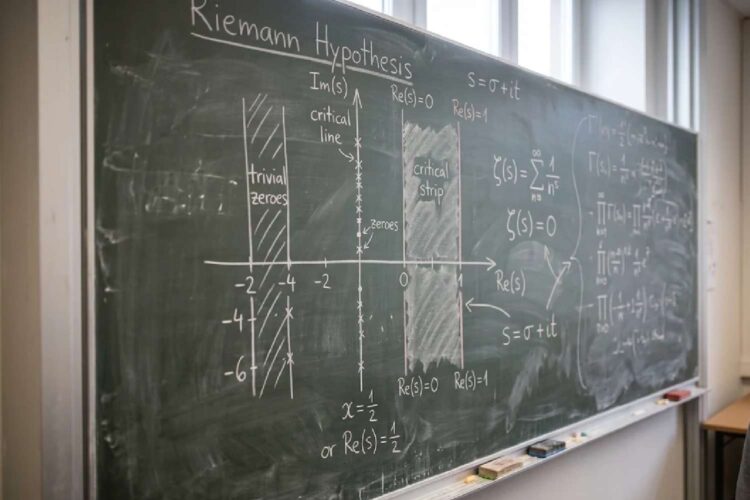
That pattern is tied to the Riemann zeta function, a formula that takes in a complex number, one with a real part and an imaginary part, and returns another. The inputs that make it return zero, called zeros, each add finer detail to a count of the primes. The hypothesis says every non-obvious zero has a real part of exactly one half.
Riemann hypothesis explained: what the critical line means
The line where the real part equals one half is called the critical line. Mathematicians have long known that some zeros sit on it, and computers have checked huge numbers of them without finding an exception. A computer check is not a proof, because the hypothesis covers infinitely many zeros and one stray zero would break it.
Turning the hypothesis into a theorem, the term for a proven statement, would have sweeping consequences across mathematics, Scientific American has reported, including the maths behind cryptography and even nuclear physics. David Hilbert listed the problem in 1900, and in 2000 the Clay Mathematics Institute attached a $1 million prize.
Riemann hypothesis explained: how AI has gone after it
Anthropic‘s first public attempt came on Monday, 10 August 2026, when staff member Jarred Sumner prompted an unreleased version of Claude to attack the problem directly and left the mathematical choices to the model. His instruction, as Anthropic described it, was:
Take a real stab at the Riemann hypothesis.
Jarred Sumner, Anthropic staff member
Claude did not prove it. It raised the proven share of zeros on the critical line from 41.6% to 67.2%, a related result that specialists Brian Conrey and Dan Goldston examined. James Maynard, a mathematician at the University of Oxford, told Scientific American that the techniques behind it could not reach the full problem. He said:
No pathway for any of these approaches to deal with the actual Riemann hypothesis.
James Maynard, University of Oxford
OpenAI followed on 6 October 2026 with a claimed proof of the quasi-Riemann hypothesis, a weaker version, which Quanta Magazine reports human experts have since examined. Alpöge’s note, released on Friday, 20 November 2026, goes further, and its opening line states the claim:
I believe I have, working with Claude, discovered a proof of the Riemann Hypothesis.
Levent Alpöge, Anthropic mathematician
Sources
- Anthropic, Learning more about Claude's mathematical capabilities (10 August 2026)
- Scientific American, No, Anthropic's AI didn't just solve math's hardest problem
- Scientific American, The million-dollar math problem hardly anyone is trying to solve
- Quanta Magazine, AI Proved the Quasi-Riemann Hypothesis. What Happens Now? (19 October 2026)
- Clay Mathematics Institute, Millennium Prize Description and Rules
- Britannica, Millennium Problem
- AFP via Phys.org, Anthropic researcher says he and Claude proved the Riemann hypothesis, first posed in 1859 (20 November 2026)
- TechSpot, Anthropic's Claude tried to solve the Riemann hypothesis and found something new instead