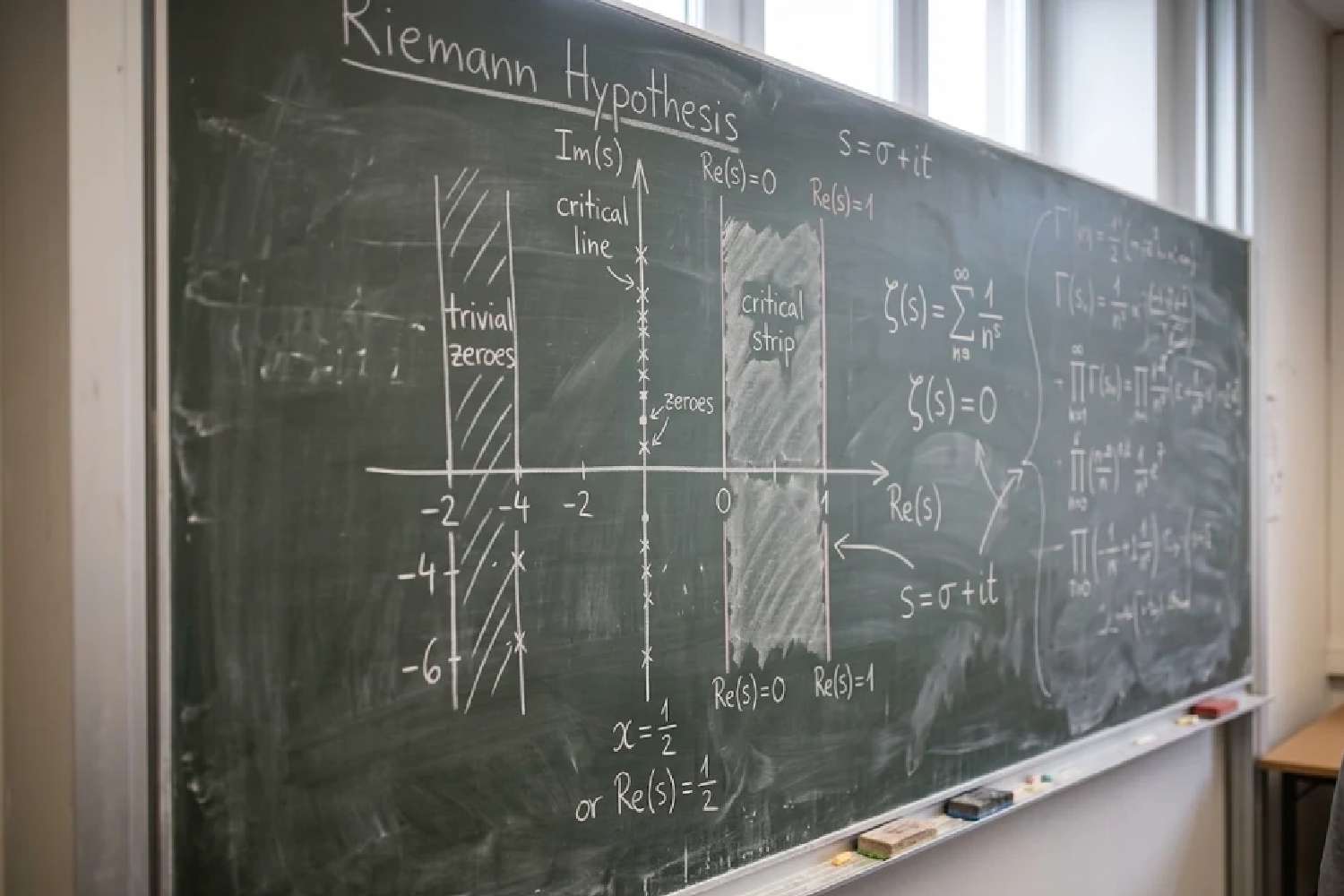


Riemann hypothesis proof: Anthropic mathematician Levent Alpöge claimed on Friday, 20 November 2026, that he and Claude found one, and experts are checking it.
According to AFP, Alpöge said in a four-page note released on Friday that he used Claude, Anthropic’s AI chatbot, to prove the Riemann hypothesis, a question about how prime numbers are distributed that German mathematician Bernhard Riemann first posed in 1859. No paper has been published. The proof exists only as computer code.
Alpöge is a mathematician on the technical staff at Anthropic, the company that builds Claude, and he posted the note on his personal website. It says the same method also settles the Generalized Riemann Hypothesis, a broader version that covers a whole family of related functions, and that both results are fully formalised in the Lean proof language.
Riemann hypothesis proof: what Alpöge’s note says
The note is written in the first person, and a footnote says the informal, AI-generated draft material ran past 250 000 pages. The author says the argument is too long and unfinished for a readable write-up yet. The opening line states the claim plainly:
I believe I have, working with Claude, discovered a proof of the Riemann Hypothesis.
Levent Alpöge, Anthropic mathematician
Lean is a proof assistant, software that accepts a mathematical argument only if every step follows from the rules of logic. The code is released in 14 compressed archive parts, and Andrew Sutherland, a mathematician at MIT, reported that all 175 187 Lean modules compiled and passed a replay through Lean’s kernel, the core checker, using only the three standard axioms.
Riemann hypothesis proof: who has checked it so far
A clean compile shows the code is internally consistent, not that the final theorem states what mathematicians mean by the hypothesis. Elliot Glazer of Principia Labs said the formalised statement is in fact the Generalized Riemann Hypothesis, and he estimated the chance of a bug in Lean at under 1%.
Scott Aaronson, a computer scientist at the University of Texas at Austin who writes a blog on quantum computing and mathematics, gave his early assessment of the claim in a blog post about the Lean files. He wrote:
Not 100% sure, but my bet is that the proof will stand.
Scott Aaronson, University of Texas at Austin
Anthropic posted a related result on Monday, 10 August 2026: an unreleased Claude raised the proven share of the zeta function’s zeros on the critical line from 41.6% to 67.2%, which fell short of a proof. Brian Conrey, one of two specialists who examined that paper, told AFP about the new claim:
It’s really the biggest thing I think that’s ever happened in mathematics.
Brian Conrey, Riemann hypothesis specialist
Riemann hypothesis proof: what happens next
Neither the Clay Mathematics Institute nor Anthropic had issued a statement on the claim by Saturday, 21 November 2026. The hypothesis is one of seven Millennium Prize Problems with a $1 million prize from the institute, whose rules require publication in a qualifying outlet, then two years and general acceptance, so no award could come before late 2028.
Sources
- AFP via Phys.org, Anthropic researcher says he and Claude proved the Riemann hypothesis, first posed in 1859 (20 November 2026)
- OfficeChai, Claimed Riemann Hypothesis Proof Made With Claude Appears On Anthropic Mathematician Levent Alpöge's Website (20 November 2026)
- Kingy AI, Levent Alpöge claims a Riemann hypothesis proof with Claude (20 November 2026)
- Fello AI, Riemann Hypothesis Solved? The Claude Proof Claim Explained (20 November 2026)
- Quantum Zeitgeist, Riemann Hypothesis: New Claude Proof Claim, 167-Year Problem (20 November 2026)
- Anthropic, Learning more about Claude's mathematical capabilities (10 August 2026)
- Clay Mathematics Institute, Millennium Prize Description and Rules