

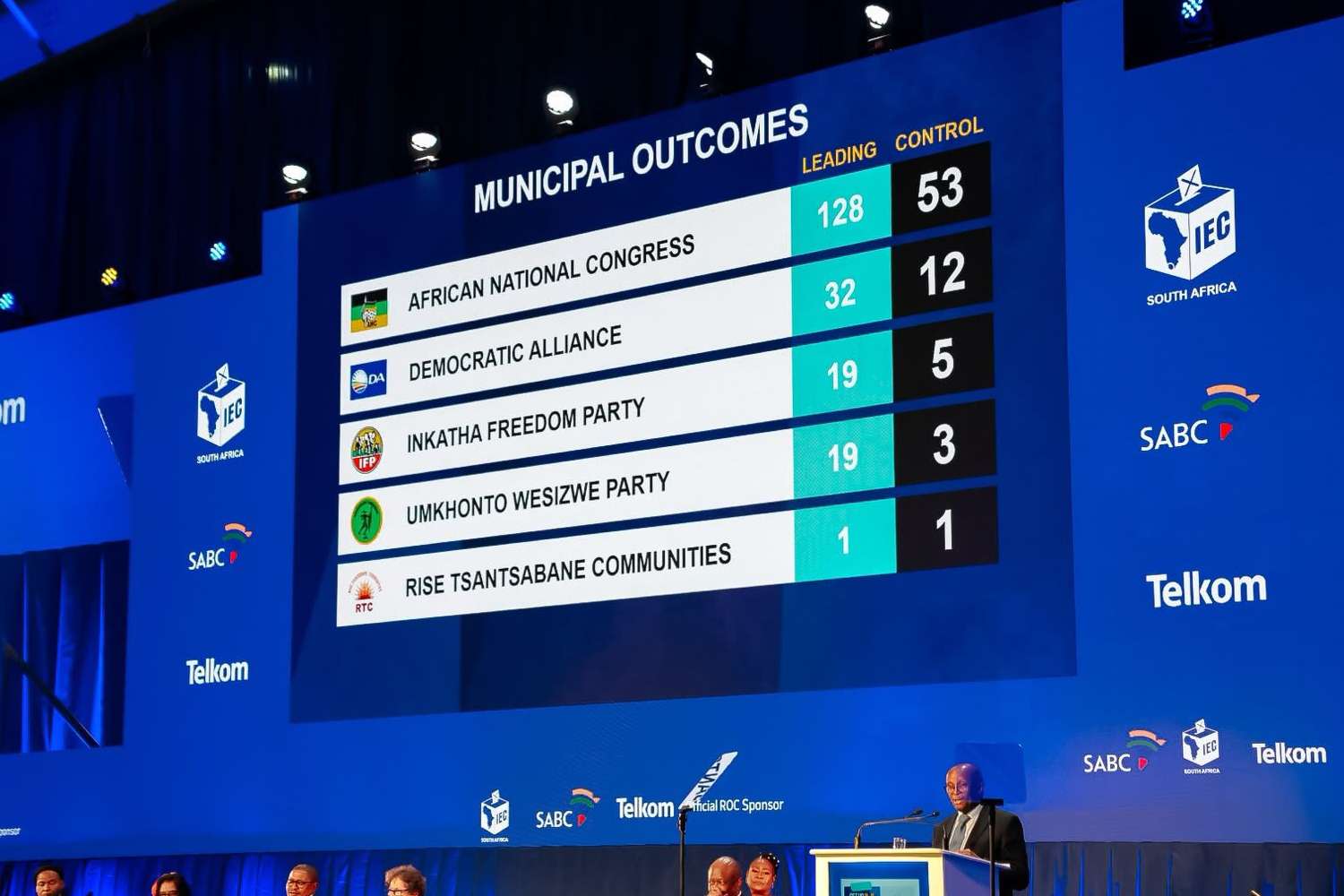


Local government elections 2026 were declared free and fair by the Electoral Commission of South Africa (IEC) on Sunday, 8 November 2026, leaving the African National Congress (ANC) at 30.76% and 127 councils hung.
According to the IEC, national turnout was 52%, up 6.1 percentage points from 45.9% in 2021. Chairperson Mosotho Moepya announced the final results at the National Results Operation Centre in Midrand on Sunday, 8 November 2026, with 212 of 213 municipal councils finalised and a new vote ordered at one Douglas voting station.
Local government elections 2026: How the final results split
The ANC won 30.76% of the national vote and 3 246 council seats, down from 45.59% in 2021, but remained the largest party. The Democratic Alliance (DA) took 24.64% and 1 695 seats, the uMkhonto weSizwe (MK) Party 9.76% and 785, the Economic Freedom Fighters (EFF) 6.22% and 588, and ActionSA 5.67% and 313.
The ANC controls 53 municipalities outright and leads in 128, while the DA controls 12 and leads in 32. The Inkatha Freedom Party (IFP) controls five and the MK Party three. In 127 councils, no party holds more than 50% of seats, up from 70 after the 2021 elections.
Why the IEC declared the vote free and fair
Moepya said the commission weighed the safeguards put in place for the vote, feedback from voters and objections received before reaching its finding, and described the election as largely peaceful. President Cyril Ramaphosa, Cooperative Governance Minister Velenkosini Hlabisa and Home Affairs Minister Leon Schreiber were at the ceremony, where Moepya declared:
I am pleased, on behalf of the IEC, to declare the 2026 Local Government Elections free and fair.
What the local government elections 2026 mean for coalitions
Under section 29(2) of the Local Government: Municipal Structures Act, a municipal manager must convene a council’s first meeting within 14 days of the declaration, which puts the deadline at Sunday, 22 November 2026. There is no legal deadline for parties to conclude coalition agreements, and the City of Cape Town is the only metro where one party won an outright majority.
How the local government elections 2026 shape the road to 2029
The ANC lost its parliamentary majority in the 2024 national election, which led to the Government of National Unity (GNU), where the ANC governs alongside the DA, the IFP and other parties. The 2026 poll was the first local election since the GNU was formed, and the next national and provincial elections are due in 2029.
The Mapungubwe Institute for Strategic Reflection (Mistra) reported in its 2026 Coalitions Barometer, released on Wednesday, 7 October 2026, that 80 of the 213 councils were hung at some point between the 2021 elections and February 2026.
After thanking voters, candidates, parties, election staff and observers, Moepya addressed the councillors elected on Wednesday, 4 November 2026, many of whom now face the task of forming governments in 127 hung councils, and told them:
The ballot paper has given you a mandate and a responsibility.
Sources
- SAnews, IEC declares LGE 2026 free and fair (8 November 2026)
- eNCA, IEC declares 2026 Local Government Elections free and fair
- IOL, IEC declares elections free and fair, orders fresh vote in Douglas in Northern Cape (8 November 2026)
- Mail & Guardian, ANC barely hangs on as DA and ActionSA make gains in final IEC results (8 November 2026)
- Inside Politics, ANC slumps to historic low of 30.76% as MK Party surges, hung councils soar in LGE 2026
- BusinessDay, EXPLAINER: How are coalition governments formed after the 2026 local government elections? (9 November 2026)
- Daily Maverick, Coalition Barometer warns of more hung councils (7 October 2026)
- EWN, LGE 2026: Basic services, fading loyalties loom over South Africa's vote (30 October 2026)
- TimesLIVE, Watershed year looms as local elections test South Africa's fragile political order (3 January 2026)
- Swisher Post, Local government elections 2026: How to vote on polling day
- Swisher Post, Local elections 2026: Metros to watch for coalition deals


