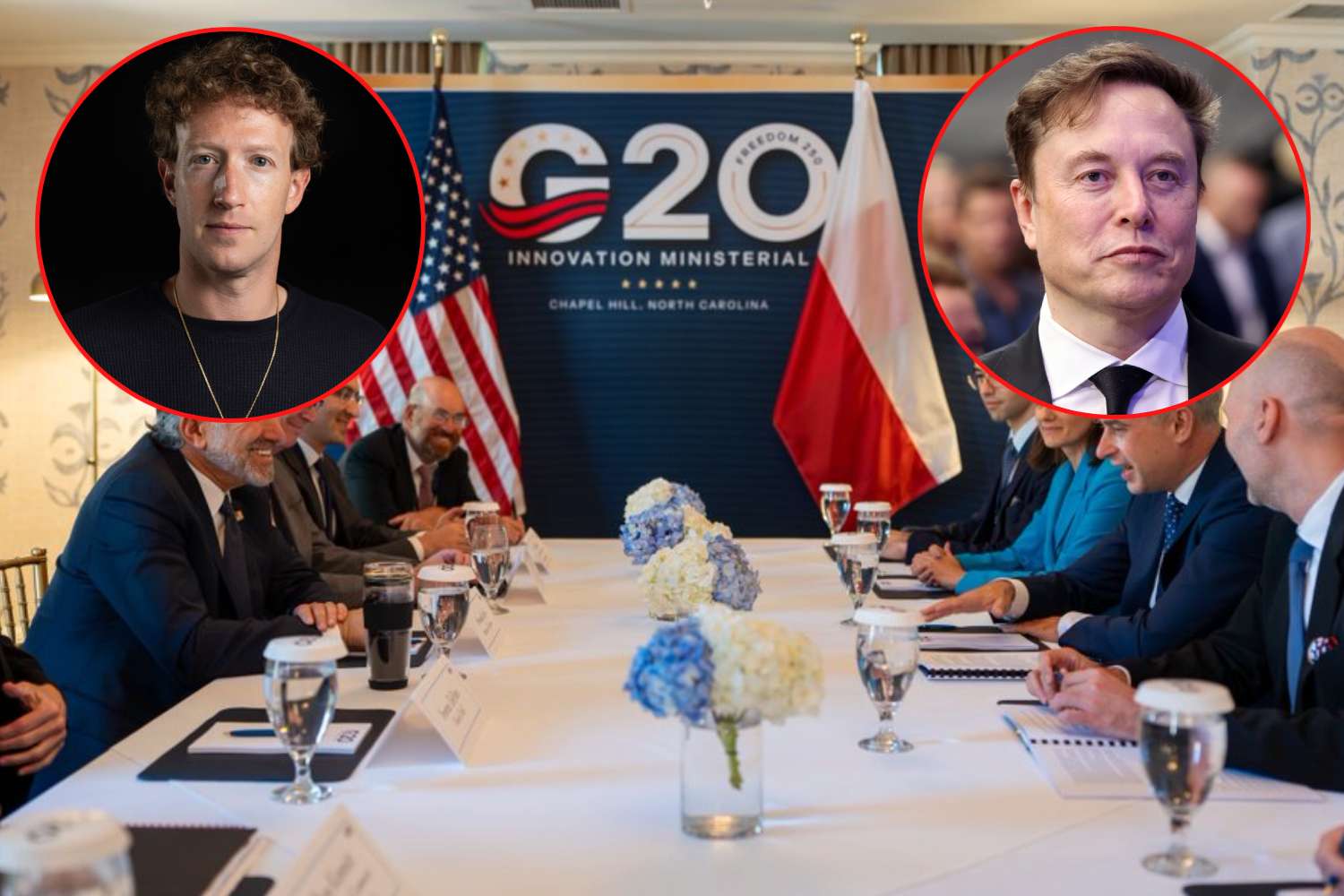


Mark Zuckerberg and Elon Musk both joined the G20 Innovation Ministerial in Chapel Hill, North Carolina, by video link on Tuesday, 1 September 2026, as world leaders and technology executives pushed for a major AI data centres build-out.
The two-day ministerial ran at the Carolina Inn under US Commerce Secretary Howard Lutnick and White House science adviser Michael Kratsios, as reported by WRAL.
Zuckerberg and SpaceX chief executive Musk joined several technology leaders, including Google DeepMind’s Demis Hassabis, as delegations weighed how fast AI should move.
The Zuckerberg Musk AI data centres case
Zuckerberg’s contribution leaned on economics rather than hardware. The Meta chief executive told the session that the money and the headcount a founder needs before the first customer arrives would fall sharply, a change in the arithmetic of starting up:
“I would expect that the cost of starting a business is going to go way down. It’s going to take way less capital in the future, maybe way less people to get started.”
His second point was a caution about purpose. Automation that only replaces work people already do, he argued, misses the target; the payoff sits in invention, in systems producing things that did not exist before:
“If AI can’t help us invent things and is primarily technology used to automate things that people can do without creating new things, then that has a lot of problems.”
Drug discovery and the AI data centres bill
Demis Hassabis, chair of Google DeepMind Technologies, spoke to what the compute was meant to buy. He took drug discovery, where finding a molecule that behaves as intended had historically taken years, and set out a target rather than a result:
“We hope eventually to get that down from years to months, maybe even one day weeks, and maybe tackle hundreds of diseases.”
Ambition of that size ran into a power bill. The sessions covered AI investment and workforce development before landing on whether existing energy infrastructure can carry what new AI data centres would draw, a constraint measured in megawatts, not chips.
The AI data centres protest in Chapel Hill
Chapel Hill authorities increased law enforcement presence around the Carolina Inn for the forum. Protesters had gathered over Interstate 40 on Monday, 31 August 2026, objecting to the pace of AI development, and a second demonstration was set for 10:00 (16:00 SAST) on Wednesday, 2 September 2026, on the University of North Carolina campus.
Kim Winz, one of the protesters, did not argue that the work should stop. Her objection was to the speed of it, and to the distance between how quickly these systems ship and how slowly their effects become clear:
“I want them to think carefully and to slow down. And I think that AI has a lot of potential and a lot of promise, but also a lot of danger.”
Day two at the Carolina Inn
The forum did not end with the Tuesday session. OpenAI chief executive Sam Altman was scheduled to speak on Wednesday, 2 September 2026, with Nvidia’s Jensen Huang expected in person for a fireside chat with Lutnick, adding the chip supply side of the build-out.